Circular Economy
Bützberg composting hall enters commissioning at 90,000 tonnes
Bützberg's new 120-by-30-metre composting hall enters commissioning with up to 90,000 tonnes of annual capacity, using Sutco's WENDELIN to turn digestate into compost.
Waypoints
The 120-by-30-metre composting hall officially opened in October 2026 and entered feedstock commissioning.
Planned annual organic-waste capacity is 90,000 tonnes, including 70,000 tonnes of household biowaste and 20,000 tonnes of garden waste.
Biowaste ferments in 21 digesters; biogas is upgraded to biomethane for the public gas grid before digestate enters composting.
A WENDELIN can handle 40,000–120,000 tonnes a year and mix 260 cubic metres per hour, depending on machine size.
Digestate becomes high-quality compost after around five weeks in the hall.
Bützberg’s expanded composting operation in Hamburg is designed to treat up to 90,000 tonnes of organic waste a year, nearly doubling the facility’s previous annual capacity.
By Rebecca Stone
MVR Müllverwertung Rugenberger Damm GmbH operates the Bützberg biogas and composting facility as a subsidiary of Stadtreinigung Hamburg, the city’s public waste management company. Its new composting hall, 120 metres long and 30 metres wide, officially opened in October 2026 and has entered commissioning with feedstock.
What feedstock will the new hall treat?
The planned 90,000-tonne annual capacity covers about 70,000 tonnes of biowaste from Hamburg households and 20,000 tonnes of garden waste. The feed includes potato peelings, coffee grounds and hedge clippings.
Because the expansion occupies an existing site, MVR required a treatment line that could process larger quantities of organic waste while using available space efficiently. The operator selected a solution tailored to Bützberg and entrusted Sutco with delivering the line, with WENDELIN at its core.
Ralf Müller, head of Sutco RecyclingTechnik’s Biology Division, said: “Bützberg shows what WENDELIN does best: turning large quantities of organic material evenly and reliably, around the clock, in a building where every square metre counts.”
How does WENDELIN turn digestate into compost?
Before composting, the biowaste ferments in 21 digesters at Bützberg. The resulting biogas is upgraded to biomethane and fed into the public gas grid; the remaining digestate moves into the new hall.
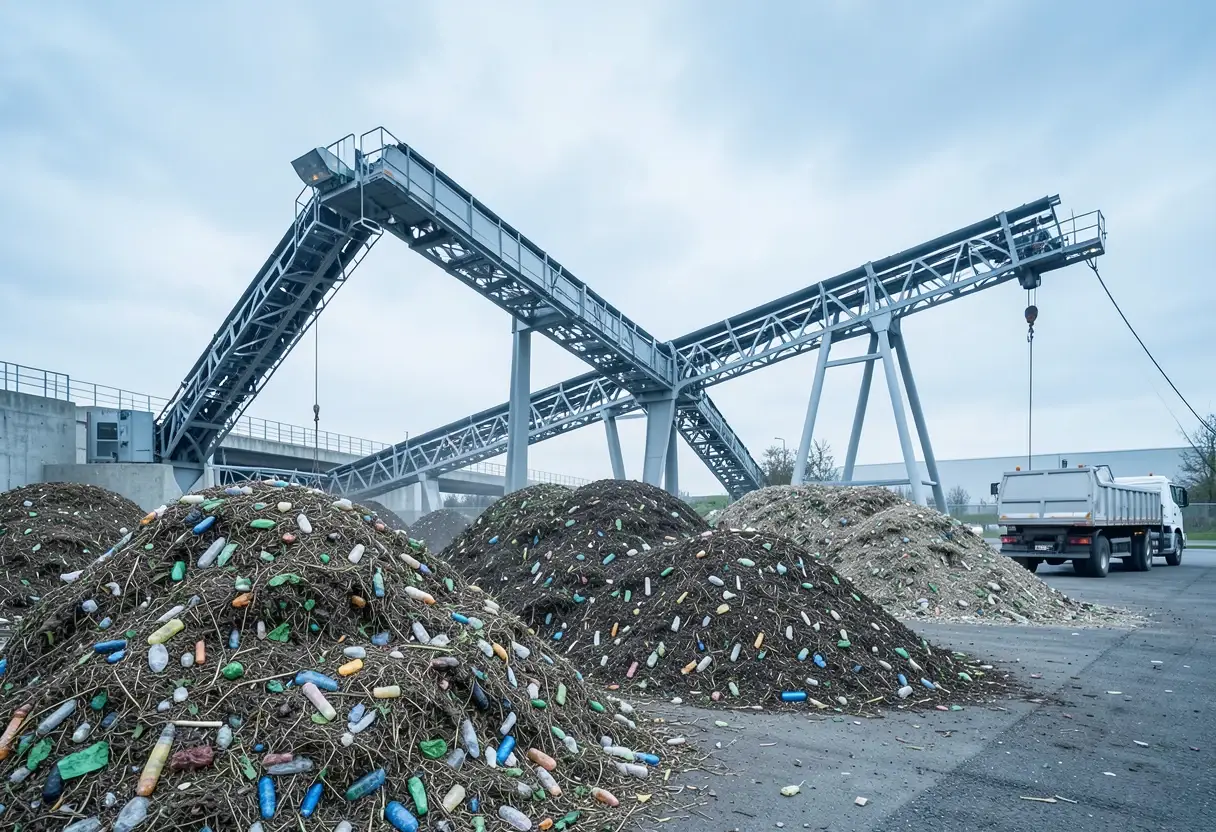
Sutco’s WENDELIN travels above the windrows on a mobile crane bridge. Slowly rotating bucket wheels dig into the material layer by layer, turn and loosen it, and pass it to an integrated conveyor that redistributes the material in an even stack.
Each turn introduces fresh oxygen, supports microbial activity and helps maintain a controlled composting process that largely runs itself, with minimal manual work.
After around five weeks in the hall, the digestate becomes high-quality compost for agriculture, horticulture and landscaping, returning valuable organic matter to the natural cycle. Before that stage, biogas from the digesters enters the public gas grid as biomethane, giving the overall process two recovered outputs.
How much can the system handle?
Depending on its size, one WENDELIN can handle 40,000 to 120,000 tonnes a year and mix up to 260 cubic metres of material an hour, Sutco said.
Sutco says the system is designed for 24/7 operation, runs under its own plant-control system and requires minimal staffing. Its low-wear, low-maintenance design limits interruptions to planned servicing.
At Bützberg, WENDELIN forms part of a coordinated treatment line covering material feed, turning, aeration, moisture control and discharge. Controlled aeration supports the biological process, while moisture levels can be adjusted to keep composting conditions uniform.
At the end of the process, WENDELIN passes the finished material to a discharge conveyor. Automation supports reliable operation and helps MVR fit higher treatment capacity into the existing hall.
When will regular operation begin?
MVR said rising requirements for biowaste recovery called for controlled, reliable and highly automated processing at larger scale. Sutco delivered the treatment line in response, positioning Bützberg as a new reference for biological waste treatment.
During commissioning, WENDELIN and the rest of the system are being tested under real operating conditions and fine-tuned before regular operation begins. Sutco describes Bützberg as another reference in biological waste treatment and evidence that robust engineering and automation can convert high volumes of biowaste into a resource.
The next milestone is completion of feedstock commissioning and the start of regular operation at the stated capacity. Until the plant sustains that throughput, the expansion remains under commissioning rather than proven at full scale.
via waste-management-world.com (Source)
More from Rebecca Stone
Show full bio
News editor covering companies, deals and strategy in Circular economy and the environmental industry at Circular Wire.
495 articles