Industrial Decarbonization
Air Liquide Completes 'Golden Weld' Tie-In to Porthos CO2 Pipeline
Air Liquide has welded its Rozenburg Cryocap capture plant into the shared Porthos CO2 pipeline, completing the final onshore link to North Sea storage 3.5 km below the seabed.
Waypoints
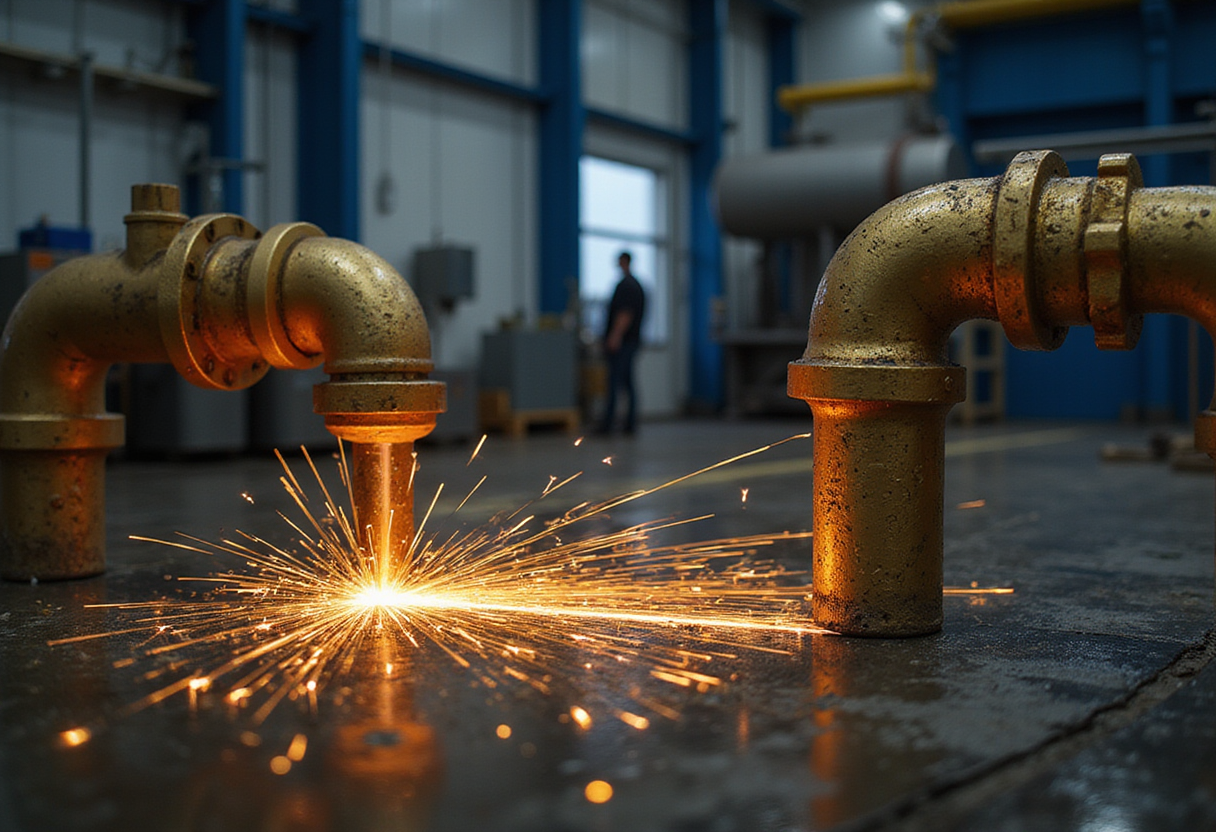
Air Liquide completed the 'golden weld' tying its Rozenburg plant into the Porthos CO2 pipeline in Rotterdam.
Air Liquide is one of four Porthos anchor customers, alongside Shell, Air Products and ExxonMobil.
CO2 will be compressed at Maasvlakte and injected via the P18-A platform into depleted gas reservoirs 3.5 km beneath the North Sea seabed.
Air Liquide has completed the so-called "golden weld" connecting its Rozenburg industrial site to the Porthos carbon dioxide transport pipeline in Rotterdam, closing the final onshore link between an individual industrial emitter and the shared CO2 gathering network now under construction in the Port of Rotterdam.
The tie-in is a physical milestone in a larger integration project: Air Liquide is building a carbon capture facility at Rozenburg based on its proprietary Cryocap cryogenic capture technology, which will pull CO2 from industrial gas production at the site. Until now, that capture plant existed as a standalone construction project. With the golden weld finished, the facility has a hard-piped route into the collective Porthos transport and offshore storage system.
Air Liquide is one of four anchor industrial customers behind Porthos, alongside Shell, Air Products and ExxonMobil. Each customer is responsible for capture at its own facility; Porthos supplies the shared transport and storage leg. The Air Liquide connection demonstrates how that division of responsibility plays out in steel and welds: one emitter's capture unit, one tap into a common line.
Once commercial operations begin, captured CO2 from Rozenburg will move through the shared gathering pipeline to a central compression station at the Maasvlakte. There the stream will be pressurized and dispatched via an offshore trunkline to the P18-A platform in the North Sea. Injection follows into depleted offshore natural gas reservoirs sitting roughly 3.5 kilometers (2.2 miles) beneath the seabed, where the CO2 is intended to remain permanently stored.
That geology matters to the material balance. Depleted gas fields offer proven containment and known pressure behavior, which is why the Porthos consortium has built its storage concept around them rather than saline aquifers. The offshore chain — compression, trunkline, platform, injection wells — is the part of the system that converts an onshore industrial byproduct into a permanently sequestered stream.
"We welcome this 'golden weld' as a true illustration of joint progress," said Martijn Lub, project manager at Air Liquide. "Large-scale decarbonization in the Port of Rotterdam requires strong, collective effort, and this connection to the Porthos CO2 pipeline shows what we can achieve when we collaborate together."
For Rotterdam's industrial cluster, the significance of the weld is structural rather than symbolic. CCS in the port depends on shared infrastructure economics: no single emitter could justify an offshore trunkline and platform conversion alone, but four anchor customers sharing one pipeline can. Each completed tie-in moves the system closer to the utilization threshold at which the transport and storage assets operate as designed.
The distinction between built capacity and announced projects remains one to watch. The golden weld is complete physical infrastructure — the connection exists. The Cryocap capture facility at Rozenburg, by contrast, is still under construction, and commercial CO2 flow has not started. The two must converge before tonnes move.
The same applies cluster-wide. Shell, Air Products and ExxonMobil must each finish their own capture buildouts and tie-ins before the Porthos system carries its design volumes to the North Sea. The Air Liquide weld is the first visible proof that an anchor customer's onshore facility and the shared network are physically compatible.
What decides what happens next is the commissioning sequence: completion of the Rozenburg capture plant, startup of the Maasvlakte compression station, and first injection at P18-A. When those milestones land, the port's CCS chain will shift from construction status to operating tonnage — the number against which every circularity and decarbonization pledge in the Rotterdam cluster will ultimately be measured.
via airliquide.com (Original)
More from Elena Vasquez
Show full bio
Senior reporter covering media and advertising at Circular Wire.
114 articles