Cleantech & Investment
Perovskite panels, shippable arrays and solid-state transformers headlined RE+ in Las Vegas
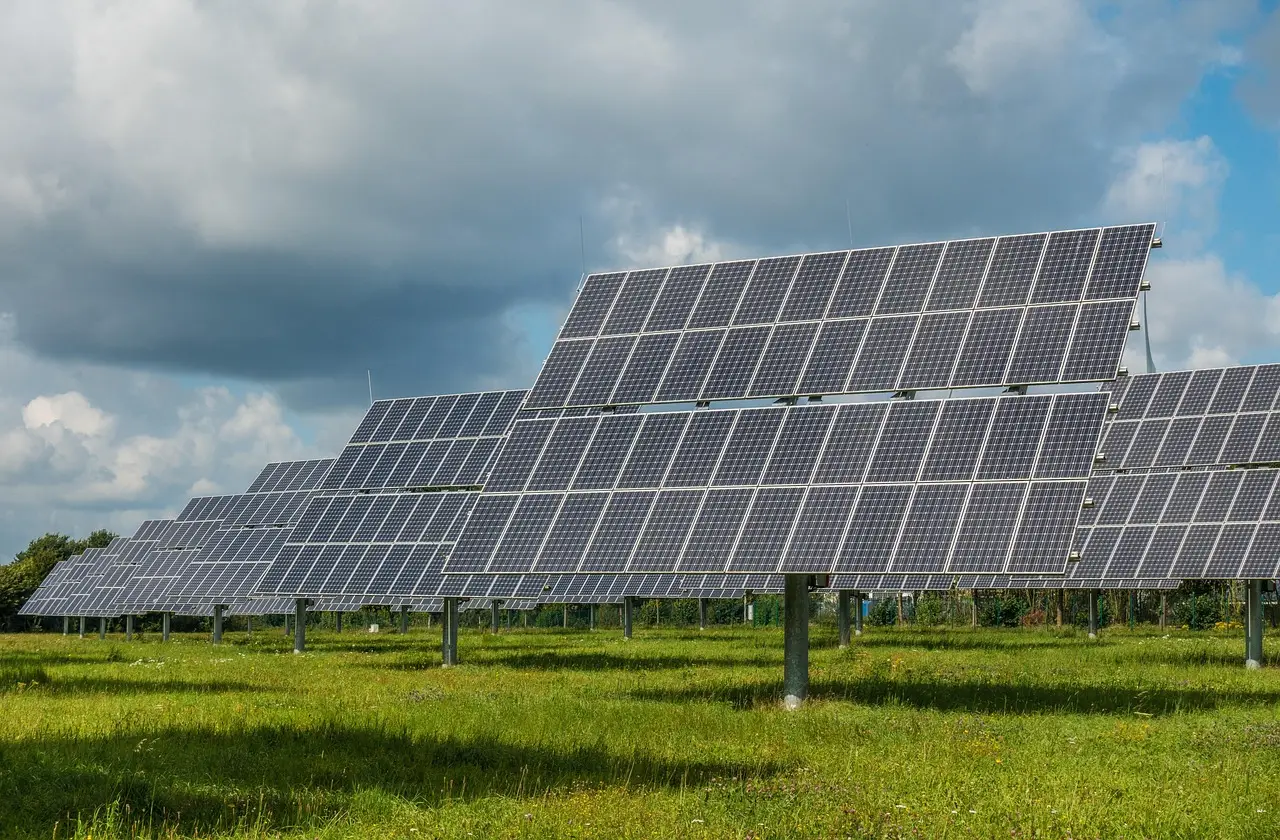
RE+ in Las Vegas showcased 27% perovskite-silicon panels from Caelux and Heliene, EG4's $2.62-per-watt shippable home array, and solid-state transformers from Tesla and Enphase due next year.
Waypoints
Heliene advertises Caelux-coated perovskite panels at 27% efficiency, up from 24% previously.
Caelux is expanding its Los Angeles factory to 100 MW per year of perovskite glass.
EG4's Homestead 60 offers a 7-kW array and 60-kWh battery at $2.62 per watt with storage.
Enphase's solid-state transformer prototype conditions 2.5 MW; Tesla has shipped 3 TW of power converters.
Tesla and Enphase aim to begin shipping solid-state transformers next year.
A 27%-efficient silicon-perovskite panel, a $37,700 plug-in home microgrid and two solid-state transformer launches defined the technology agenda at RE+, the U.S. solar industry's largest annual convention, held for the first time at the Las Vegas Convention Center.
The event, hosted by the Solar Energy Industries Association and the Smart Electric Power Alliance, arrived after two years of political uncertainty for solar and wind developers. Attendees now anticipate supportive policymaking aimed at lowering energy costs, and the exhibition floor reflected an industry that kept building through the downturn. Displays included not only solar panels but batteries, grid transformers, EV chargers, electronics packages for data centers and surviving green hydrogen ventures.
"If you look at how broad RE+ has become, it's no longer solar and batteries anymore," said Raghu Belur, chief products officer at Enphase, the microinverter maker. "It's all elements that interconnect to a more modern, sophisticated grid."
Booths touting American-made solar and batteries, once rare, were commonplace. Claims of compliance with "foreign entity of concern" rules, which Republicans imposed last year to restrict tax credit eligibility, appeared across the floor.
What did Caelux and Heliene show?
Startup Caelux prints perovskites as a thin film on standard solar glass at a Los Angeles factory and ships the glass to Heliene, a Minnesota module assembler. Heliene displayed the full-size silicon-perovskite panel at the show; the coating appears as an inky midnight wash over the blue silicon cells, with narrow pinstripes channeling production through the same two cables as conventional products.
"Essentially, it's the same as installing a regular module," said Aaron Thurlow, Caelux's chief commercial officer.
Heliene advertises the panel at 27% efficiency, up from its previous 24% standard. CEO Martin Pochtaruk noted the current leading design, TOPCon, "is asymptotically getting to the maximum possible capacity for that technology." He said the booth drew a crowd between noon and 4 p.m. that emptied his printed data sheets.
Caelux and Heliene are shipping small numbers of panels to paying customers to test real-world durability, the key hurdle before market adoption. Caelux awaits certifications such as UL labels and is expanding the LA factory to 100 megawatts per year — an inconsequential volume in today's market, so the startup aims to build a gigafactory. Qcells and Tandem PV have also staked claims to the first perovskite gigafactory.
Can factory-built arrays cut residential costs?
Texas-based EG4 Electronics launched the Homestead 60, a 7-kilowatt solar array pre-wired and assembled on a steel frame, delivered off a truck bed and positioned in a yard like a trailer. It pairs with a 60-kilowatt-hour battery, among the largest residential storage products marketed, forming a round-the-clock microgrid.
Founder James Showalter targets sparsely populated regions that door-to-door rooftop sales have bypassed. Standardizing factory work — the homeowner needs an electrician only to connect the inverter — lets EG4 advertise $1.20 per watt for solar only and $2.62 per watt with storage, versus nearly $3 per watt for the average residential ground-mount system on the EnergySage marketplace. A set of four racks and a battery still costs $37,700.
The product is an engineering efficiency play rather than a novel component bet; Tesla's solar roof and building-integrated solar efforts fell short of their promises, but the Homestead relies on proven parts. It enters a market searching for cost reductions after the loss of federal tax credits, with panels already cheap and installation and packaging costs the next frontier.
Why are solid-state transformers coming?
Transformers, a 140-year-old technology, are in short supply, and the bottleneck is delaying solar projects and data centers alike. The trend at RE+: adapting smart inverters to perform transformer work with mass-produced modular components, paralleling how solar and batteries replaced complex turbomachinery.
Tesla Energy alum Drew Baglino launched Heron Power to commercialize solid-state transformers. Tesla released its own version, Powercore, drawing on power electronics expertise from electric roadsters and its grid-storage business. The company has shipped 3 terawatts of power converters across all products, Tesla Head of Energy and Charging AJ Booth said.
"I think it's the most advanced version out there, and then it's also backed by Tesla with our history of being able to do this in high volume at scale," Booth said. "It really simplifies the supply chain and allows projects to be installed faster."
Enphase showed a prototype solid-state transformer — roughly 528 smaller boxes in one enclosure converting and conditioning 2.5 MW, with the main product planned at twice that size. Enphase onshored manufacturing in 2023, so its entry strengthens constrained domestic supply. "There's nothing wrong with horses and buggies, but we moved away from them," Belur said. "The grid needs to modernize."
Neither Tesla nor Enphase ships yet. Both aim to start deliveries sometime next year, the milestone that will decide whether the announcements become capacity.
via canarymedia.com (Source)
More from Rebecca Stone
Show full bio
News editor covering companies, deals and strategy in Circular economy and the environmental industry at Circular Wire.
553 articles